


Blog
Laser Welding Machine Guide

Laser Welding Machine Guide: Faster, Cleaner Metal Joining
A laser welding machine gives manufacturers a way to join metal with concentrated heat, narrow welds, and controlled distortion. It can help workshops improve appearance, reduce finishing work, and complete jobs faster than conventional processes. However, the best results depend on choosing the power level, cooling system, controls, optics, and operating setup.
This guide explains how laser welding works, where it creates value, what buyers should compare, and how to select equipment for production needs. You can also explore Flama Welding’s current laser welding machine range below.
What Is a Laser Welding Machine?
A laser welding machine uses a focused beam of light to generate heat at the joint between parts. The energy is concentrated locally, so the operator can form a narrow weld while limiting unnecessary heat around the joint. The process can produce a smooth seam with relatively little spatter.
Unlike MIG welding, laser welding does not always require a filler wire. Some joints can be fused directly when the parts fit closely together. Filler wire may still be used when joint conditions require it.
The technology is available in automated cells and handheld systems. A handheld laser welding machine places the welding head in the operator’s hands, making the process practical for cabinets, doors, stainless-steel products, frames, enclosures, kitchens, signs, and other fabricated components.
How Laser Welding Creates a Controlled Joint
The laser source sends energy through an optical delivery system to the welding head. The head focuses that energy onto the workpiece. Once the beam reaches the joint, the metal melts and forms a weld pool. Shielding gas protects the molten area from atmospheric contamination and supports a cleaner result.
Several settings influence the weld. These include laser power, travel speed, beam pattern, focus position, shielding-gas flow, wire-feed rate, and the angle of the welding head. Material type and thickness also matter. Therefore, operators should begin with approved parameter ranges and then qualify the process for each production job.
Joint preparation remains important. Laser welding performs best when surfaces are clean and parts fit consistently. Oil, paint, rust, moisture, and excessive gaps can reduce quality. Good fixtures can improve alignment, repeatability, and operator confidence.
Why Manufacturers Choose Laser Welding
A laser welding machine can create several practical advantages when the application is suitable. First, concentrated heat may reduce the size of the heat-affected zone. This can help limit warping on thin sheets, polished panels, and visible components.
Second, a controlled seam can reduce grinding, straightening, and cosmetic correction. Less post-weld finishing saves labor and helps protect brushed or polished surfaces. It can also shorten the time between welding, cleaning, inspection, and final assembly.
Third, handheld operation can be easier to learn for certain straightforward seams. That does not remove the need for training, supervision, or process qualification. However, a stable system with clear controls can help a workshop standardize repeat jobs.
Common Materials and Applications
Laser welding is widely considered for stainless steel, carbon steel, galvanized sheet, and selected aluminum applications. Actual compatibility depends on the alloy, coating, thickness, joint design, laser source, shielding gas, and qualified settings.
Stainless-steel fabricators often value the process because appearance matters. Commercial kitchens, railings, cabinets, electrical enclosures, doors, tanks, furniture, and architectural products may all contain long visible seams. A neat weld can reduce polishing time and improve presentation.
Thin carbon-steel components can also benefit from controlled heat. Manufacturers of boxes, frames, shelves, machinery covers, and general sheet-metal products may use laser welding to improve throughput. Aluminum requires closer attention to reflectivity, heat behavior, cleanliness, and parameters, so buyers should discuss specific alloys and thicknesses before selecting equipment.
Handheld Laser Welding Machine or Conventional Welder?
Laser equipment does not replace every MIG or TIG system. Each process has strengths. A MIG welding machine remains highly practical for general fabrication, structural work, varied joint gaps, and applications that need substantial filler metal. Meanwhile, TIG welding equipment gives experienced operators detailed control for precision work, pipe, thin materials, and specialized alloys.
A handheld laser welding machine is especially attractive when speed, low distortion, and clean appearance are priorities. It is less forgiving of poor fit-up, dirty surfaces, and inconsistent joint geometry. Therefore, the decision should follow the work.
Air-Cooled Versus Water-Cooled Systems
Cooling is one of the most important purchasing decisions. Air-cooled designs can offer a compact footprint and simpler mobility. They may suit lighter production, field movement within a facility, or workshops that value an integrated package. Flama Welding lists an air-cooled all-in-one laser welder for buyers comparing this format.
Water-cooled systems use a cooling circuit to manage heat during operation. They are commonly considered when duty demands are higher or when the selected laser configuration requires more thermal management. Buyers can review Flama’s water-cooled laser welder as another available system type.
Neither option is automatically better. Compare expected welding time, ambient temperature, maintenance capacity, mobility, floor space, power requirements, and production intensity. The supplier should confirm the recommended duty pattern for the exact model.
Features to Compare Before Buying
Start with laser output and the qualified material-thickness range. More power is not always the best answer. Excess capacity can increase cost without improving jobs that mainly involve thin sheet. Too little power, however, may slow travel or limit penetration.
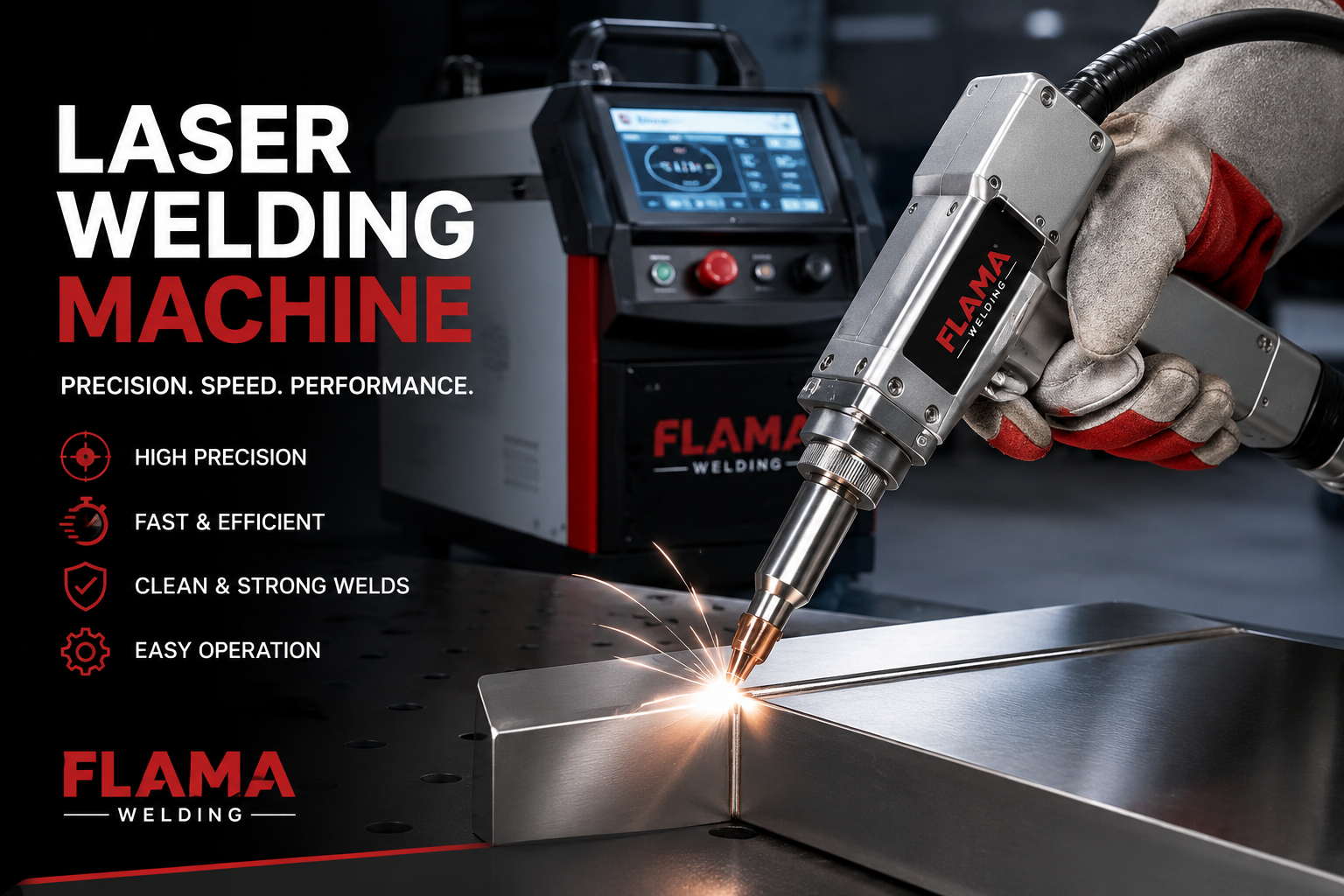
Next, review the welding head and controls. A clear interface makes parameter selection easier. Flama’s handheld laser welder is presented with a seven-inch display, adjustment controls, a water cooler, low-current welding capability, and an integrated control system.
Also compare beam modes, supported wire feeders, welding-head weight, cable length, torch consumables, protective lenses, nozzles, safety interlocks, alarms, and stored programs. Ask how quickly operators can change between materials and whether settings can be protected from accidental adjustment.
Power supply requirements deserve equal attention. Confirm voltage, phase, frequency, breaker capacity, grounding, and local electrical compliance before ordering. In addition, identify the required shielding gas and estimate normal consumption.
Safety Must Shape the Installation
Laser welding requires a controlled safety plan. The beam can harm eyes and skin, while reflected energy can create hazards beyond the immediate weld point. Ordinary welding curtains and standard arc-welding eye protection should not be assumed to provide adequate laser protection.
A proper installation may require a controlled laser area, access restrictions, warning signs, suitable barriers, interlocks, approved protective eyewear, fume extraction, fire prevention, and documented operating procedures. The exact controls depend on the equipment classification, beam wavelength, national rules, and risk assessment.
Training should cover startup, shutdown, parameter control, reflections, workpiece positioning, protective-lens inspection, gas handling, emergency response, and maintenance. Operators must also understand that shiny, curved, or angled metal can reflect energy unpredictably.
Consult qualified laser-safety specialists and applicable regulations before commissioning the machine. Productivity should never come at the expense of safe operation.
Calculate the Full Cost of Ownership
The purchase price is only one part of the investment. Include installation, electrical work, extraction, shielding gas, filler wire, protective lenses, nozzles, safety equipment, training, maintenance, and spare parts.
Then compare potential savings. A laser welding machine may reduce welding time, grinding, polishing, distortion correction, and rejected parts. It may also help a business increase capacity without adding the same amount of finishing labor.
Use real production figures. Select several representative products, record current labor time, and estimate the new cycle. Include preparation and inspection, not only arc-on time. A realistic trial or sample-welding test can reveal whether the expected savings are achievable.
Prepare Your Workshop for Better Results
Create parameter sheets for approved jobs. Record the material, thickness, joint type, gas, power, speed, beam settings, wire details, and inspection standard. This makes training easier and helps different operators achieve repeatable results.
Plan consumable inventory as well. Protective lenses and nozzles should be available before production begins. Assign responsibility for inspections and cleaning. Small maintenance tasks can prevent avoidable downtime and protect optical components.
Selecting a Reliable Supplier
A capable supplier should do more than provide a quotation. Share your materials, thicknesses, joint drawings, daily workload, electrical supply, safety expectations, and required finish. Ask for recommended parameters, sample results, training details, consumable lists, warranty terms, and technical support.
Flama Welding’s company profile explains its manufacturing background and broader welding-equipment activity. Buyers can also browse the complete Flama product shop when comparing laser, MIG, TIG, stick, plasma, battery-powered, and automation-related equipment.
For a more accurate recommendation, send representative drawings and application details through the Flama Welding contact page. A focused technical discussion is more useful than choosing a system from power ratings alone.
Make the Decision Around Your Production
A laser welding machine can transform suitable fabrication work by combining speed, concentrated heat, clean seams, and reduced finishing. Still, the strongest return comes from matching the system to real products rather than buying on headline power alone.
Evaluate materials, thicknesses, joint quality, cooling, controls, electrical requirements, safety, consumables, and support. Then test representative parts and calculate the complete workflow. With the right preparation, training, and supplier guidance, laser welding can become a reliable production tool instead of an expensive experiment.