


Blog
Welding Machine Guide: How to Choose The Right Welder

Welding Machine Guide: How to Choose the Right Welder for Better Results
A welding machine is more than a power source that creates an electric arc. It influences bead appearance, penetration, productivity, operating cost, and operator confidence. Choosing the wrong machine can make a simple job frustrating. Choosing the right one can improve consistency, reduce rework, and increase workshop productivity.
However, buyers often compare welders only by maximum amperage or price. Those numbers matter, but they are not the complete story. The best welding machine is the one that matches your materials, thickness range, power supply, production volume, working environment, and expected level of control. This guide explains key factors behind a practical purchasing decision.
Begin With the Work, Not the Machine
Before comparing models, define the work the machine must perform. A maintenance technician has different requirements from a stainless-steel fabricator, automotive body shop, or heavy-structure factory.
Start by identifying the metals you weld most often. Mild steel is compatible with several processes, while stainless steel and aluminum may require more precise process selection and additional controls. Next, consider the normal material thickness. Thin sheet needs stable low-current performance and good heat control. Thick plate needs greater output, suitable electrodes or wire, and a duty cycle that can support longer welding periods.
Also consider where the work happens. A portable unit may be important for construction, field repair, and installation teams. A larger industrial system may be better for a fixed production line where output, cooling, wire capacity, and continuous performance matter more than weight.
Stick Welding Machines for Strength and Simplicity
Stick welding, also known as MMA or SMAW, remains one of the most practical choices for construction, repair, agriculture, pipelines, and general metalwork. The process uses a flux-coated consumable electrode and does not require an external shielding-gas cylinder. This makes it useful outdoors and in locations where wind could disturb gas coverage.
A stick welding machine is often selected for its simple setup, portability, and ability to handle less-than-perfect surface conditions. Nevertheless, electrode selection, operator technique, polarity, and amperage still affect the finished weld.
For workshops that need straightforward equipment, Flama’s MMA and SMAW welding machine range includes economy, professional, industrial, gouging, and submerged-arc-related options. Buyers working with demanding electrodes or heavier fabrication can also review the BT STICK 400/500 as an example of a higher-output stick platform.
MIG Welding Machines for Productive Fabrication
MIG/MAG welding, or GMAW, feeds a continuous wire through the torch. Because the operator does not need to stop repeatedly to replace electrodes, the process can support fast, efficient production. It is widely used for fabrication, manufacturing, automotive work, furniture, structural components, and general workshop projects.
A MIG welding machine can be especially attractive when appearance and speed are important. Still, buyers should look beyond amperage. Wire-feed stability, synergic control, pulse functions, spool capacity, torch quality, and duty cycle can strongly influence performance.
Synergic machines simplify setup by coordinating related parameters. Pulse and dual-pulse functions can improve heat management and bead control in suitable applications. For a broad view of available configurations, explore Flama’s MIG/MAG welding machines, including economy, synergic, pulse, and multi-process categories.
For more advanced fabrication, the BT MIGDP 2506 PFC MV combines multi-voltage operation, power factor correction, synergic control, dual pulse, support for a large wire spool, and a heavy-duty cycle. These features illustrate why two machines with similar headline amperage may serve very different users.
TIG Welding Machines for Precision and Clean Control
TIG welding, or GTAW, is chosen when weld quality, control, and appearance take priority. It allows the operator to control the arc and, when required, add filler metal separately. The process is frequently used on stainless steel, aluminum, thin materials, pipework, precision components, and visually exposed joints.
A TIG welding machine should provide a stable arc, even at low amperage. Buyers may also need high-frequency starting, pulse adjustment, remote-current control, water-cooling compatibility, and AC capability. DC TIG is commonly used for steels and stainless steel, while AC/DC equipment is generally preferred when aluminum forms part of the workload.
Flama’s TIG welding machine collection includes economy, DC, and AC/DC options for different production needs. The BT TIG 251 PFC is one example available within the AC/DC category. When comparing TIG units, focus on the controls you will actually use rather than paying for functions that do not fit your materials or projects.
When a Multi-Process Welding Machine Makes Sense
A multi-process welding machine can combine MIG, stick, and TIG-related capabilities in one power source. This approach is useful for workshops that handle varied jobs but have limited space, mobile service teams that cannot transport several machines, and businesses that want flexibility while their workload is still developing.
However, “multi-process” should not automatically mean “best.” A dedicated machine may offer a more specialized interface, stronger output, or features designed specifically for one process. Compare the expected workload carefully. A multi-process unit is a smart choice when flexibility is genuinely valuable, not simply because the specification list is longer.
Power Supply, PFC, and Multi-Voltage Operation
Electrical compatibility must be checked before purchase. Confirm the available input voltage, phase, frequency, plug or connection requirements, and the capacity of the electrical circuit. A powerful industrial welding machine may not perform correctly on an undersized supply.
Multi-voltage capability can be valuable for contractors, distributors, and workshops that operate in different regions or facilities. Power Factor Correction, usually shown as PFC, is another feature found on selected inverter machines. Its practical value depends on the model and application, but buyers should evaluate it together with input-current requirements, generator compatibility, and local electrical conditions.
Never assume that a machine will work optimally simply because the plug can be connected. The power source and protective devices must be suitable for the equipment.
Understand Amperage and Duty Cycle
Maximum amperage tells you the upper output limit, but it does not reveal how long the machine can weld at that output. Duty cycle describes the proportion of a defined test period during which a welding machine can operate at a stated current before cooling is required.
For occasional repairs, a lighter duty cycle may be acceptable. In production, frequent thermal interruptions can slow output and create bottlenecks. Therefore, compare the duty cycle at the amperage you normally use, not only at a low reference current.
It is also wise to leave capacity above the normal workload. Running a machine continuously near its limit may be less practical than selecting a model with comfortable performance reserve.
Arc Quality, Controls, and Operator Experience
A stable arc helps the operator maintain control, particularly during starts, low-current welding, positional work, and delicate applications. Features such as hot start, arc force, anti-stick, pulse control, crater settings, burn-back adjustment, and inductance may improve specific processes.
More controls are not always better. An experienced production welder may want detailed parameter access, while a training center or mixed-skill workshop may benefit from a clear interface and repeatable synergic programs. The best welding machine should make correct setup easier without hiding the adjustments needed for professional work.
Consider the Complete System
The power source is only one part of the purchase. Torch type, cable length, electrode holder, earth clamp, wire feeder, trolley, cooling unit, gas regulator, foot pedal, remote control, and consumables can affect both usability and final cost.
A low purchase price may become less attractive if essential accessories must be replaced immediately. Likewise, an industrial package can offer better value when the supplied components are designed to work together. Review Flama’s complete product catalog to compare power sources and supporting equipment within the same system.
Plasma cutting may also complement a welding operation by improving metal preparation and cutting efficiency. Buyers building a complete fabrication setup can view the available plasma cutters alongside welding equipment.
Build Quality, Compliance, and Support
A welding machine is a working asset, so long-term support matters. Ask about production quality, testing, spare parts, technical documents, warranty procedures, and after-sales communication. For commercial distribution, local compliance and documentation can be as important as performance.
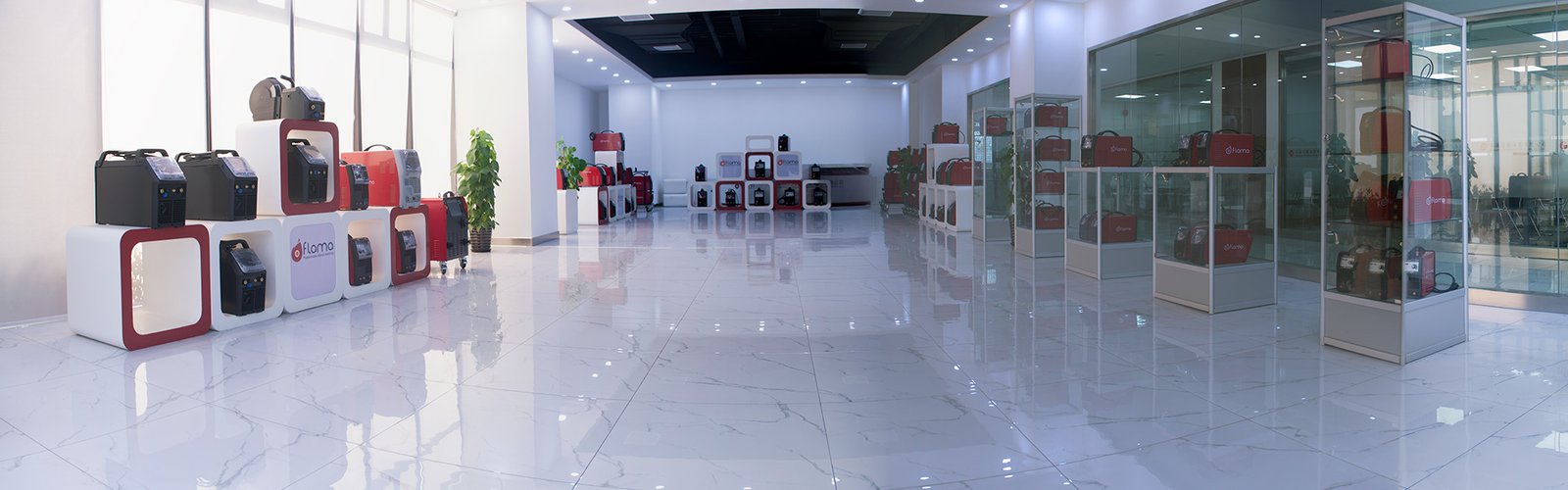
Flama states that it has manufactured inverter welding equipment since 2008 and operates production, research, assembly, and SMT facilities in Shanghai. More information is available on the Flama Welding company profile.
A Practical Final Checklist
Before ordering, confirm the main welding process, base metals, thickness range, required amperage, expected duty cycle, input power, portability, accessories, control functions, compliance needs, service support, and total delivered cost. Then compare only the machines that satisfy those requirements.
The right welding machine does not need to be the largest or most expensive model. It needs to start reliably, produce the required weld quality, fit the available power supply, support the operator, and remain productive throughout the expected workload.
Flama Welding offers equipment across stick, TIG, MIG/MAG, multi-process, and plasma-cutting categories for economy, professional, and industrial applications. Browse the Flama Welding product range or contact the Flama team to discuss the process, materials, power conditions, and production demands behind your next welding machine purchase.